
Traditional vs. Self-Publishing: Which Path Is Right for You?
Mar 31, 2026
You’ve imagined it: the moment your memoir is finally in someone’s hands. But before you can get there, you need to make a foundational decision, and it’s one most aspiring authors underestimate. Not just how to publish, but which path is genuinely right for you.
The publishing landscape has changed dramatically. There are now two serious, legitimate routes to bringing a memoir into the world—traditional publishing and self-publishing—and each asks something different of you. Neither is inherently better. Both require more than most writers expect.
Here’s what you need to know about each.
Traditional Publishing
Traditional publishing means working with an established house—the kind often grouped under the “Big Five” (Penguin Random House, HarperCollins, Simon & Schuster, Hachette Book Group, and Macmillan Publishers), and many other midsize, independent, and smaller publishing houses. Traditional publishers produce, distribute, and sell your book. In exchange for that infrastructure, you give up a degree of control, accept a longer timeline, and compete for limited spots.
Publishing industry expert Jane Friedman offers this excellent chart of how these traditional publishers operate.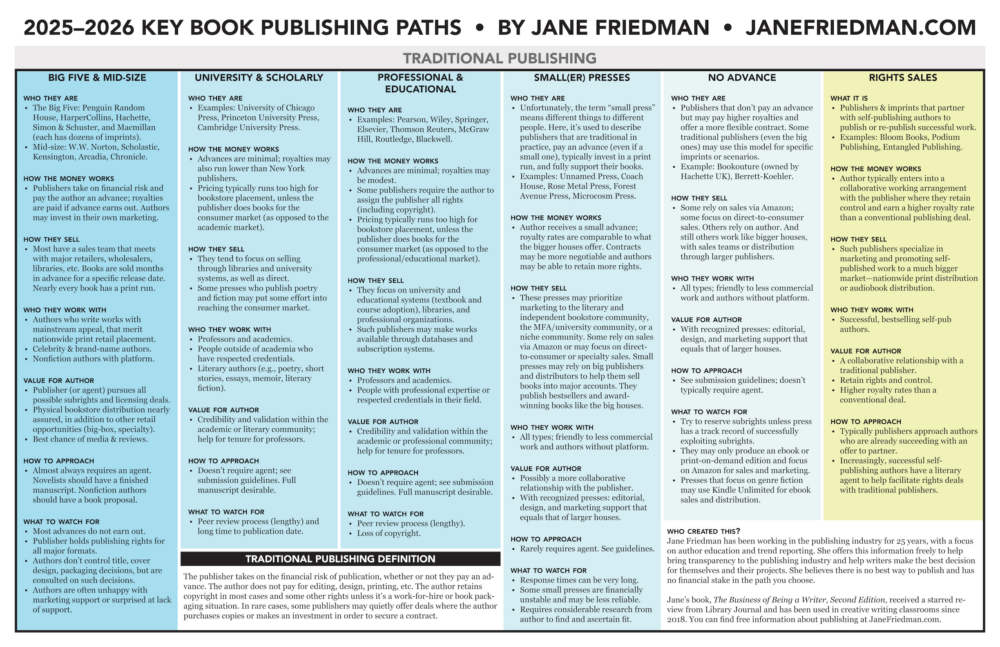
Publishers aren’t buying your story. They’re buying a positioned idea.
Before anything else, publishers need to understand what your book is, who it’s for, and why someone will buy it. A memoir about your life isn’t enough. A memoir is a book with a market. The clearer your concept, the stronger your proposal.
You’ll almost certainly need a book proposal and a literary agent.
For memoir, especially for first-time authors, the traditional path typically begins with a formal book proposal: an overview and hook, chapter outline, sample chapters, comparable titles, and a section on your author platform. That proposal goes to literary agents, not editors. Major publishers rarely accept unsolicited submissions directly.
Finding the right agent means researching who represents memoirs like yours, crafting a compelling query letter, and being prepared to hear a lot of “not for me” before you find a match. That process alone can take months.
The timeline is genuinely long. Even if everything goes well—you land an agent, the agent sells your book, the publisher acquires it—you’re typically looking at 18 to 24 months before publication. This is not a fast path. It’s a long game, and it rewards patience and persistence.
Your platform matters as much as your prose.
This surprises many writers: traditional publishers want authors who can already sell books. An email list, a social following, an established readership—these aren’t nice-to-haves. They’re increasingly part of what makes a memoir acquisitions-worthy. Publishers are taking on real financial risk; your platform reduces it.
Pros of traditional publishing:
- Professional editing, design, and production
- Established distribution into bookstores
- Industry credibility and visibility
- Advance against royalties (no upfront cost to you)
Cons of traditional publishing:
- Highly competitive to break into
- Limited creative and editorial control
- Long, uncertain timeline
- You still have to market your own book
Self-Publishing
Self-publishing means you own every decision and every task. Through platforms like Amazon KDP or IngramSpark, you can bring a book to market on your own terms and timeline. It’s more accessible than ever. It’s also more demanding than it looks.
Self-publishing doesn’t mean skipping the fundamentals. The planning work that traditional publishing requires—a clear concept, a defined audience, a thoughtful structure—still applies. Skipping it doesn’t make your book faster; it makes it weaker. Writers who approach self-publishing with the same rigor they’d bring to a proposal tend to produce far better books.
You manage every stage of production.
Editing, cover design, interior formatting, metadata, pricing, uploading—all of it falls to you. That doesn’t mean you do it alone. Many self-published authors hire professional editors and designers, which represents a real upfront investment. But you direct the process and make the final calls.
You are entirely responsible for marketing.
This is true in traditional publishing, too, but there’s at least a team behind you. In self-publishing, audience-building is yours alone. Without a readership to launch to, even a beautifully produced memoir can go unread.
Pros of self-publishing:
- Complete creative and editorial control
- Faster path from manuscript to market
- Higher royalty rates per copy sold
- No gatekeeper; accessible to any author
Cons of self-publishing:
- You manage every aspect of production
- Upfront financial and time investment
- No built-in distribution support
- Harder to reach physical bookstore shelves
The Real Difference: Control vs. Support
The most persistent myth in publishing is that traditional equals better and self-published equals lesser. Neither is true. The quality of a memoir is determined by the writing, the editorial process, and the production, not the imprint on the spine.
The real distinction is structural:
- Traditional publishing: More institutional support, less personal control, longer timeline, lower financial risk.
- Self-publishing: Full creative ownership, more personal responsibility, faster timeline, higher financial investment.
Neither path removes the need to write a compelling book. Neither removes the need to build an audience. The question is which set of trade-offs you’re willing to accept.
The Part Most Writers Overlook: You Need Readers Before You Publish
Whatever path you choose, you are writing for someone. That isn’t just a marketing consideration; it’s a craft one. Knowing your reader shapes every decision, from what you include to how you structure the arc of your story.
When your book is published, it enters a crowded market. Memoir is one of the most competitive genres in publishing. Without an existing readership—an email list, a community, an audience that’s been following your work—even a well-written, professionally produced book can struggle to find its way.
Building that readership before publication isn’t optional. It’s part of the work.

Which Path Is Right for You?
Choose traditional publishing if you:
- Want the backing of an established publisher
- Have or are actively building a strong platform
- Are willing to navigate a long, competitive process
- Want wide bookstore distribution
Choose self-publishing if you:
- Want creative and editorial control
- Prefer a faster path to publication
- Are willing to manage (or hire for) production
- Have a clear audience to launch to
A Final Word
Publishing a memoir is genuinely hard. It requires more than writing. It asks you to think like both an author and a publisher: to understand your audience, to position your story, to build a readership, and to see the project through a long and often uncertain process.
And it’s worth it. Every year, writers on both paths bring their stories into the world. The total number of new titles being published each year in the US—combining self-published and traditionally published titles—is approximately 3 million.
Some of the most powerful memoirs of the past decade have come from self-published authors. Some have come through major houses. The path matters far less than the clarity you bring to it.
What the best memoir writers share isn’t a publishing deal or a platform; it’s intention. They know what story they’re telling, who they’re telling it to, and why it matters. That’s where every path begins.
Whichever road you choose, the work starts the same way—with a story worth telling, and the commitment to tell it well.